


'Avatar' vs. 'Up in the Air': The most symbolic Oscar race since 'Forrest Gump' vs. 'Pulp Fiction'
 1/03/2010 11:38:00 AM
 kenmouse
, Posted in
kenmouse
, Posted in
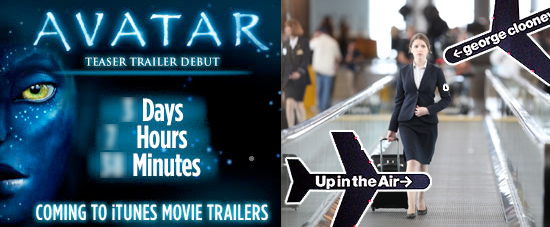
On Academy Awards night, the moment just before the announcement of the Best Picture winner is always, of course, intensely dramatic — even if it’s one of those years when it has become obvious, by the end of the night, which film is going to win (hello The Sting, Gandhi, The Silence of the Lambs, Titanic). But the Oscars can be even more dramatic if you have no clear idea what’s going to win (hello Annie Hall, Driving Miss Daisy, Crash). And the years, to me, when they have the most drama are those in which the competition for Best Picture is dominated by two front runners, and each one of those movies stands for something radically different within the Hollywood cosmos. Then you have a horse race charged with meaning.
To me, the last Academy Awards year that really had that full-on, King Kong vs. Godzilla culture-war vibe was 1994, when the competition boiled down to Forrest Gump vs. Pulp Fiction. The fact that Quentin Tarantino’s jubilantly violent and head-twisty independent-cinema landmark had zoomed to the front ranks of the Academy Awards derby was enough to electrify the evening all by itself. Clearly, this was an acknowledgement, by the Hollywood establishment, that the indie movement was no longer just a bunch of eager rude upstarts but that it had truly arrived, and was a force to be reckoned with. But, of course, the Hollywood establishment doesn’t tend to like eager rude upstarts who rewrite the rules of their business. And so it was poetically perfect that the movie Pulp Fiction was competing against was Forrest Gump, a sentimental patriotic afflicted-hero fairy tale that seemed, in many ways, to be a kind of crowd-pleasing candy box of “mainstream” values.
That night at the Oscars, in the spring of 1995, it wasn’t just one big-hit movie facing off against another. With Forrest Gump taking on Pulp Fiction, it was square vs. street, classic-rock boomer fantasy vs. surf-rock Gen-X reality, Establishment vs. Outsider — and, since both films had gone on to become cultural touchstones, it was, in effect, a battle over the question of which mythological movie Hollywood would most like to represent its core values. Perhaps it’s no surprise that, Hollywood being Hollywood, the establishment candidate won. By contrast, the famous Best Picture moment that left a bewildered daze on Harrison Ford’s face — the surprise victory by Shakespeare in Love over Saving Private Ryan — may well have been as dramatic as they come, but not because the two films really represented competing, which is to say conflicting, values. It was a dramatic upset that signified…nothing.
I predict that the Oscar race this year will have a similar symbolic heft to the one in 1994/1995. First of all, my premise is that the Best Picture race will probably come down to two movies — and let me take just a moment to explain why. Dave Karger, in his very shrewd analysis, has already listed what he thinks the Best Picture nominees would be if there were only five of them (Up in the Air, Avatar, The Hurt Locker, Inglourious Basterds, and Precious). Out of those five, I think that Inglourious Basterds, fantastic as it is, will be seen as a kind of grateful-to-be-there, come-from-behind nominee; it’s far too naughty and reckless a movie, with too little collective critical support, to have much of a chance for nabbing Best Picture. Precious, it has become increasingly clear, may well have peaked too early, and The Hurt Locker, while it keeps racking up awards and does have that collective critical support, wasn’t a big enough hit, at least by the classic yardstick of Hollywood history, to be a likely Best Picture winner. I do think that Kathryn Bigelow could take home the Best Director prize, but my instinct tells me that the Best Picture award will probably go to a movie that’s perceived, in raw Darwinian box-office terms, as “bigger.”
That leaves Up in the Air vs. Avatar. And to me, at least, that’s a very, very symbolic race. In this case, though, it’s not Establishment vs. Outsider. It’s Old School script-driven Classic Hollywood vs. New Age post-script 21st Century Entertainment. Up in the Air is a movie of such nimble wit and craftsmanship, and such timely humanity, that it has been compared, often and justly, to the venerable films of the studio system — the screwball comedies, for instance, that were rooted in clockwork elegant screenplays, incandescent star performances, and a certain tossed-off (but, deep down, rigorously achieved) insouciance. Whereas Avatar is the eye-popping techno spectacle of the Now era: a vision so “revolutionary” that it leaves many of those pesky old-fashioned story elements behind, but (at least according to its adherents, who are legion) more than makes up for that by placing the audience directly inside an organic wonder-world, using technology to return fabulistic awe to the big screen. I may be mixed on Avatar myself, but to me that certainly sounds like a potential prescription for Oscar victory. Especially now that the jaw-dropping success of Avatar has sealed the film’s promise as a preview — and a savior — of the movie industry to come.
I don’t claim to have a clue as to how the kremlinology of this year’s voting procedures will influence all of this. But if I’m indeed right about these two films becoming the front runners, what I do know is that each one, on Oscar night, will represent a radically different, even opposed, set of dramatic/aesethetic/pop-cultural values. And so the voting, as it always does, will inevitably reflect what the majority of the Hollywood establishment has chosen as a symbol of its values. In more ways than you can count, it’s the past versus the future.
To me, the last Academy Awards year that really had that full-on, King Kong vs. Godzilla culture-war vibe was 1994, when the competition boiled down to Forrest Gump vs. Pulp Fiction. The fact that Quentin Tarantino’s jubilantly violent and head-twisty independent-cinema landmark had zoomed to the front ranks of the Academy Awards derby was enough to electrify the evening all by itself. Clearly, this was an acknowledgement, by the Hollywood establishment, that the indie movement was no longer just a bunch of eager rude upstarts but that it had truly arrived, and was a force to be reckoned with. But, of course, the Hollywood establishment doesn’t tend to like eager rude upstarts who rewrite the rules of their business. And so it was poetically perfect that the movie Pulp Fiction was competing against was Forrest Gump, a sentimental patriotic afflicted-hero fairy tale that seemed, in many ways, to be a kind of crowd-pleasing candy box of “mainstream” values.
That night at the Oscars, in the spring of 1995, it wasn’t just one big-hit movie facing off against another. With Forrest Gump taking on Pulp Fiction, it was square vs. street, classic-rock boomer fantasy vs. surf-rock Gen-X reality, Establishment vs. Outsider — and, since both films had gone on to become cultural touchstones, it was, in effect, a battle over the question of which mythological movie Hollywood would most like to represent its core values. Perhaps it’s no surprise that, Hollywood being Hollywood, the establishment candidate won. By contrast, the famous Best Picture moment that left a bewildered daze on Harrison Ford’s face — the surprise victory by Shakespeare in Love over Saving Private Ryan — may well have been as dramatic as they come, but not because the two films really represented competing, which is to say conflicting, values. It was a dramatic upset that signified…nothing.
I predict that the Oscar race this year will have a similar symbolic heft to the one in 1994/1995. First of all, my premise is that the Best Picture race will probably come down to two movies — and let me take just a moment to explain why. Dave Karger, in his very shrewd analysis, has already listed what he thinks the Best Picture nominees would be if there were only five of them (Up in the Air, Avatar, The Hurt Locker, Inglourious Basterds, and Precious). Out of those five, I think that Inglourious Basterds, fantastic as it is, will be seen as a kind of grateful-to-be-there, come-from-behind nominee; it’s far too naughty and reckless a movie, with too little collective critical support, to have much of a chance for nabbing Best Picture. Precious, it has become increasingly clear, may well have peaked too early, and The Hurt Locker, while it keeps racking up awards and does have that collective critical support, wasn’t a big enough hit, at least by the classic yardstick of Hollywood history, to be a likely Best Picture winner. I do think that Kathryn Bigelow could take home the Best Director prize, but my instinct tells me that the Best Picture award will probably go to a movie that’s perceived, in raw Darwinian box-office terms, as “bigger.”
That leaves Up in the Air vs. Avatar. And to me, at least, that’s a very, very symbolic race. In this case, though, it’s not Establishment vs. Outsider. It’s Old School script-driven Classic Hollywood vs. New Age post-script 21st Century Entertainment. Up in the Air is a movie of such nimble wit and craftsmanship, and such timely humanity, that it has been compared, often and justly, to the venerable films of the studio system — the screwball comedies, for instance, that were rooted in clockwork elegant screenplays, incandescent star performances, and a certain tossed-off (but, deep down, rigorously achieved) insouciance. Whereas Avatar is the eye-popping techno spectacle of the Now era: a vision so “revolutionary” that it leaves many of those pesky old-fashioned story elements behind, but (at least according to its adherents, who are legion) more than makes up for that by placing the audience directly inside an organic wonder-world, using technology to return fabulistic awe to the big screen. I may be mixed on Avatar myself, but to me that certainly sounds like a potential prescription for Oscar victory. Especially now that the jaw-dropping success of Avatar has sealed the film’s promise as a preview — and a savior — of the movie industry to come.
I don’t claim to have a clue as to how the kremlinology of this year’s voting procedures will influence all of this. But if I’m indeed right about these two films becoming the front runners, what I do know is that each one, on Oscar night, will represent a radically different, even opposed, set of dramatic/aesethetic/pop-cultural values. And so the voting, as it always does, will inevitably reflect what the majority of the Hollywood establishment has chosen as a symbol of its values. In more ways than you can count, it’s the past versus the future.
 ROBERT Pattinson and Kristen Stewart got rather tipsy over New Year!


 The benchmark for a successful launch keeps changing, and Apple's own record is mixed as we await the "iSlate" entry.
 With "Ip Man", Donnie succeeded to hand out last year's most stunning results in the Movie circle, earning 66Millions (HKD, currency used in this article) becoming the best earner of the year. For the females, it's Barbie Xu (DaS) who had switched battle to the Movies only for the recent years,with her talent fees getting to 2 Millions per film, she earned 8 Millions last year, even surpassing the movie queens like Zhou Xun and Li Bing Bing !
 Google is expected to ring in the new year by unveiling its own smartphone on Tuesday, the Nexus One, in a bid to expand its powerful Web brand in the booming mobile arena.



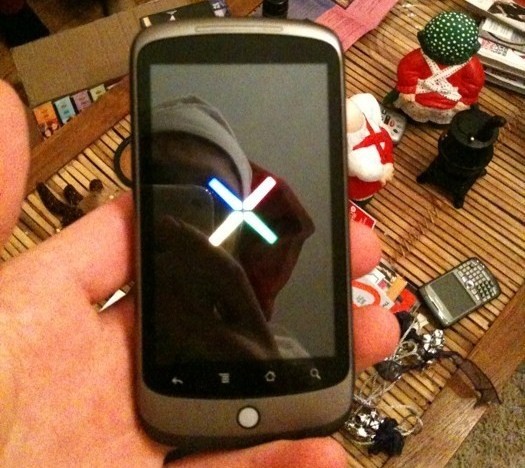 Since leaked specifications, FCC testing and hands-on evidence regarding the Google Nexus One seemingly confirmed that the Android 2.1 smartphone would only support 3G/UMTS on T-Mobile USA, those AT&T subscribers eyeing up the handset have been steadying themselves for a diet of EDGE-only data. That diet may not be quite so concrete, however; a last-minute rumor has filtered through to BGR that Google will also be offering a second, unlocked Nexus One which would support AT&T 3G bands.
 Palm’s App Store has reached a milestone. According to WebOS School, Palm now offers 1000 apps to its mobile users on its App Catalog. Of course, this number has to be taken with a grain of salt. Apple’s App Store has over 100,000 apps and the Android market has over 16,000 apps, making Palm’s achievement a little less thrilling.


 Paula Abdul could get the last laugh on American Idol bosses when she joins Simon Cowell as a judge on the buzzed-about US version of the entertainment titan’s UK talent show, The X Factor.


